Sunday, March 21, 2021

First ever Rhododendron Conservation Day celebrated at Darhal Malkan

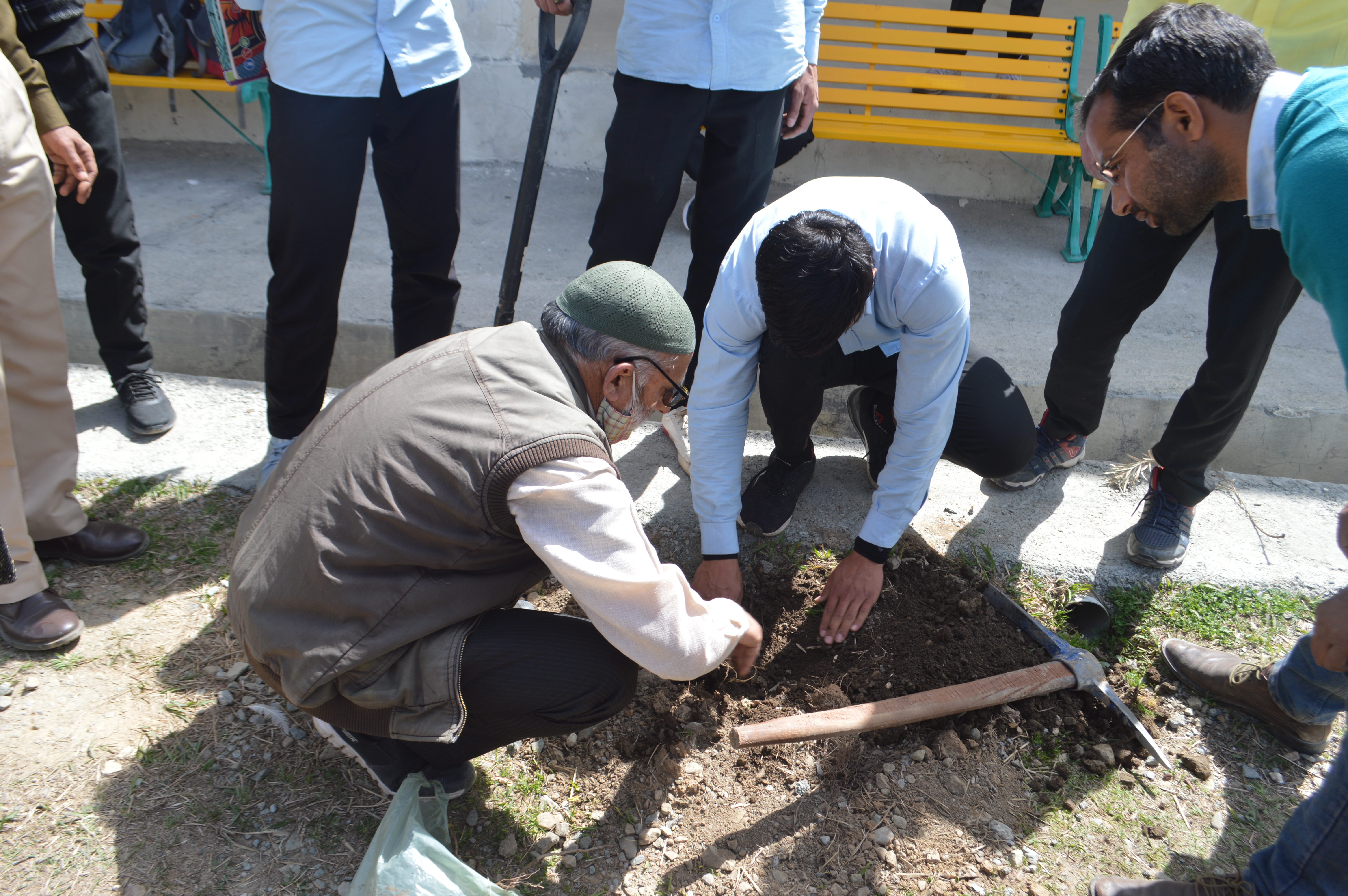
 Although Rhododendron is a very popular plant among many communities and nations, it is national flower of Nepal, state flower of Washington and West Virginia in the United States, the provincial flower of Jiangxi in China and the state tree of Sikkim (Rhododendron nobile) and Uttarakhand (now another plant Saussurea obvallata) in India, but Darhal Malkan a small Himalayan village in Pirpanjal makes history of dedicating a day for its celebrations this year. Under the able guidance of Mr. O.P. Sharma Vidyarthi, a retired IFS officer and noted tree talk crusader, and after rounds of discussion with him, finally 18th March, 2021 was designated as First ever Rhododendron Conservation Day. There were several choices for its celebration, but Darhal was unanimously chosen for the cause. Again there were several institutions in Darhal, however, due to cordial and very cooperative attitude of Prof. Samnesh Jasrotia, Principal of GDC Darhal, the event was organized at his institution. Members of civil society, Wildlife Wardan-Rajouri, Mr. Mushtaq Choudhary and officials from forest Department were part of this celebration. The students and staff of college presented different activities followed by planting about a dozen saplings of Rhododenron arboreum in college premises. 

In this connection, Mr. O.P. Sharma Vidyarthi, the man behind all celebrations, spent three days in Rajouri-Poonch to spot Rhododendron and wrote a travelogue which is being reproduced in original for purpose of conservation Rhododendron and other important flora. 

Three days at Darhal
        - Om Prakash Vidyarthi 

             Morning travel through dusty bumpy road took me to distant hilly terrain of Kalidhar where I halted for a breakfast in roadside rural dhaba,Maize rotis were served with mustard leafy vegetable and pipery Zanthoxylum armatum curd sauce to connect to rural way of life.
          On the way I encountered blossoms of Red Flame bush Woodfordia fruiticosa Dhatki , Indigofera cassioides Katthi & Butea monosperma blossoms to lessen fatigue in that under construction road.
            My destination was hilly hamlet of Darhal,where atmosphere was more tranquil,clean and green.At Rajouri I visited Govt Degree C college to host Rhododendron conservation Tree Talk in the Botanical Garden where I noticed many RET taxa like Buxus wallichiana (Chikhdi), Prunus cerasoides (Van Rawadi, Pajja) under ex-situ conservation.
             After hosting Tree Talk in the college,I retreated towards rising interior hillocks,to explore & adore woods of charm. While travelling beside Himalayan cherry Prunus cerasoides trees ,I captured foliage & fruits ,Pycnonotus leucogenys white cheecked Bulbuls enjoying fruit feast in the company of camouflaged Asian Large Barbet Psilopogon viridis locally called Traihoo in Dogri Pahadi & Miyoli in Hindi.I could not notice the Barbet till it flew away leaving me flabbergasted.Bulbuls stayed back and we're not in mood of hurry to leave juicy fruits of Pajja or Van Rawadi.
           Accompanied by M. Ashaq Raza and an old forest guard ,I had a halt at old Oak tree Dargah before going ahead.On the way slim lofty tree attracted me ,what is that tree ,I enquired ,forest guard had the familiarity ,I got reply that was Dodhla.I got its twig for a closer look ,it looked new to me ,on plucking red pink foliage ,twig exuded milky latex ,I suspected it some Ficus.It was only later in the evening when forest guard helped me in getting fruiting branch ,I felt surprised to see fig arrangement ,figs grew in pairs on a bare branch.I kept guessing which species it could be,it required further study to arrive at conclusion ,I whispered while entering Rhododendron forest for showy red blossoms. 
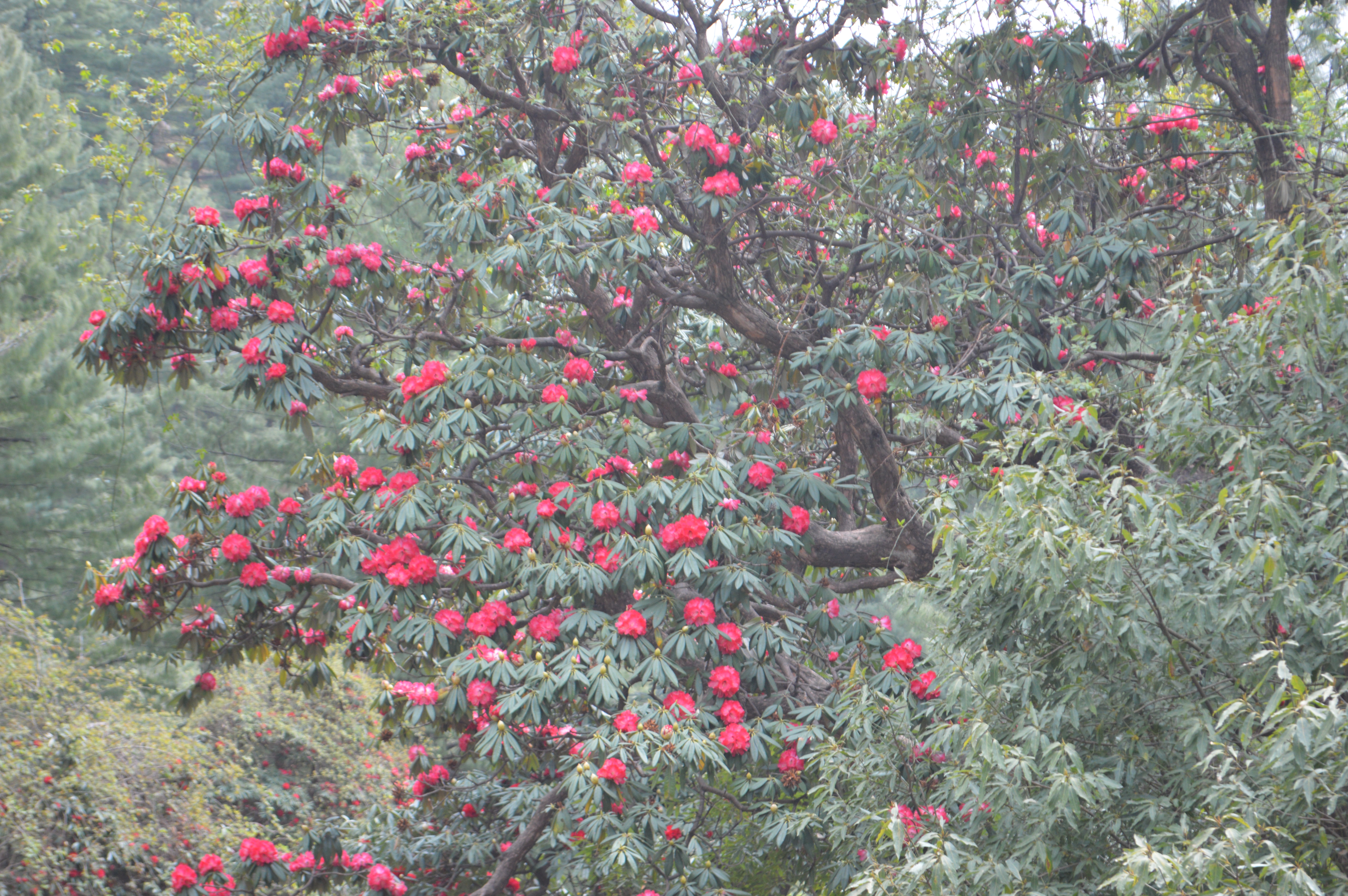
          Rhododendron trees grew in association with oak Quercus leucotrichophora Reenh रींह, Lyonia ovalifolia Ratankath रतनकाठ,Ilex dipyrena Battreenh बट्टरींह ,I was told by the guard who had ample knowledge of surrounding vegetation.After wandering uphill downhill that evening ,I visited another sacred oak tree to pay obeisance to great Saint peer baba perched on a hill top.Under old oak ,oleaster bush Elaeagnus umbellata had established itself to seek blessings of sufi saint.
            At pitch dark ,I returned to my homestay to take a rest after a strenuous jungle walk.Ficus twigs kept me captivated till morning ,I was feeling restless to known the correct binomial which I was sure to get after consulting Flora of the district Garhwal North Western Himalaya by  RD Gaur .In the morning ,I sat on the grassy carpet listening to sweet chirps of birds ,Large Asian barbet notes took me back to childhood days when I used to listen similar melodies ,Granny told Dogri name as Traihoo ,it was later during birding that I confirmed bird's identity as Psilopogon viridis ,previously named as Magalaima viridis.I captured helmet flower beauty of Scutellaria scandens after a gap of almost ten years.I was taken around by Dr M. Ashaq Raza to show driedup bushes & trees ,Sunflower family leafless bush I could not identify but I could identified dried up Chinese Paper mulberry trees identified in Botany as Brousonettia papyrifera which were introduced ,planted in hundreds in Darhal valley three decades ago but 80% mortality was expressed as matter of concern for sensitive conservationist who accompanied me with full devotion.
           Other day ,it was another wander to nearby hillock densely clothed with trees of Common oak Quercus leucotrichophora .First flowering bush which I encountered near Darhal viewpoint was Butterfly bush , Buddleja crispa ,fragrant blossoms in bunches ,I saw romance of butterflies ,Indian Tortoiseshell butterflies had patience to let me shoot beauties from different close angles ,close-up shots helped in true identity onspot.However I got it verified from Taslima Sheikh  as Indian Tortoise shell Aglais caschmirensis.Just after butterfly love ,I came across Barberry bushes , Berberis lycium shrubbery amid green regeneration of Quercus leucotrichophora ,few bushes of Punica granatum , Lyonia ovalifolia interspersed here & there.I was amazed to note bumpy tumour like swellings on stems of Berberis lycium ,yes it was bacterial manifestation ,soil bacterium Agrobacterium tumefasciens infection cause of tumours due to uncontrolled mitosis ,circular plasmid playing the role of mastermind ,getting incorporated with the DNA of host plant ,I suspected pending verification later.Mountains clad in white snow looked elegant , Rhododendron flowering forest of Dehra ki gali was in sight,I changed my mind and wished to visit distant Dehra ki gali for Rose red flowers of Rhododendron arboreum locally called Hadhdulli ,as other day event was centred around that tree under the caption - First Rhododendron Conservation Day interaction at GDC Darhal.
              While on way back ,I noticed another orange golden butterfly flying over Dandelion blossoms ,it was lemon yellow beneath and red yellow on upper wings ,it was not easy to identify ,I left verification of its identity to expert opinion later in the evening ,it was hectic woodland walk ,we started by road to reach Rhodo forest of DKG ,thanks to Botanist Ashaq Malik who took pains to drive his personal vehicle to that distant location as no other logistic support was available.
            Near to Sain ganji hill ,I was shown Marchantia palmata with stalked anthrediophores at a selected site under Rubus ellipticus bushes.I got glimpse of old Karkatshringi tree Pistacia ,unisexual flowers in dense bunches ,new leaves draped pink to add charm to the season of spring.Butea monosperma blossoms giggled in the distant landscape .
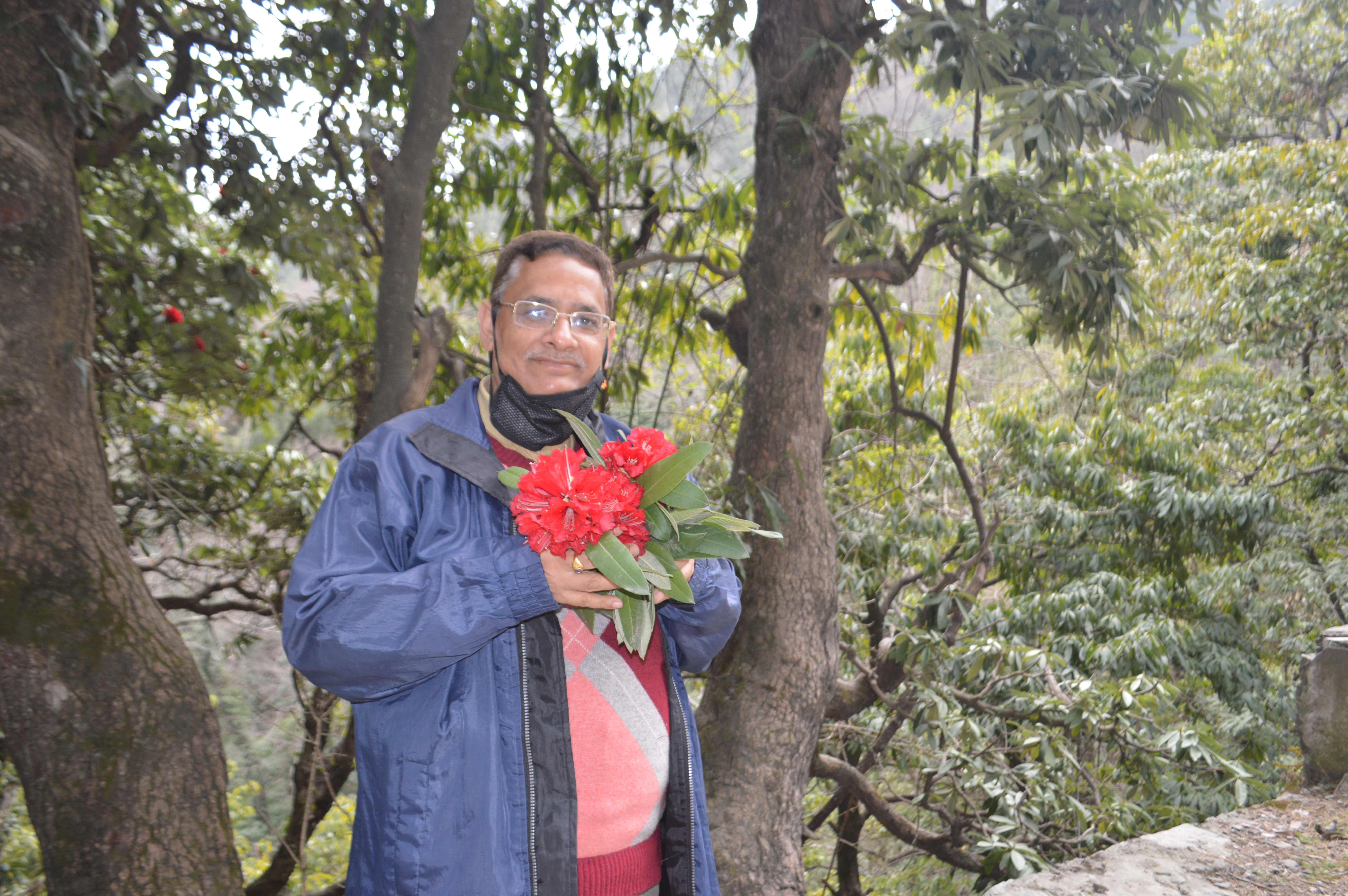
            Little up from Thannamandi ,I got allured by graceful blossoming of Prunus persica ,twigs draped in pink , Pyrus pashia with snow white flowers looked no less elegant. My ecstacy was at zenith when I got a glimpse of Rhododendron blossoms ,I made a story on spot to shed light on Rhodo features ,qualities,utilization & diversity ,trees were distant ,it was difficult to get access to flowering twigs.
           After a meal of maize rotis ,we explored downhill broadleaf forests ,got glimpse of older Rhododendron trees but I was told road widening project is on the anvil and majestic trees will not be spared by hackers.My passion for Burans blossoms is traceable to childhood visits to maternal uncle's house where I was briefed ,made acquainted about the red beauty of Rhododendron locally called Cheu. Infact it was April 2010 when I attended 2-day Rhododendron conference at Gangtok Sikkim ,I visited Rhodo sanctuary on way to Nathula pass.Sikkim has done remarkable work in declaring wildlife sanctuaries and establishing Rhododendron nurseries for field plantations of Rhodos ,out of over 1024 global species diversity ,only 90 species seen in India ,JK has just four species, Rhododendron arboreum ,R campanulatum,R anthopogon & R lepidotum ,I shared my vision.On way back near Rajouri ,I had my romance with beautiful blossoms of Sticky Ruellia Strobilanthes glutinosus beside a dusty bumpy road ,beauty of blossoms at the mercy of road construction. Golden flowers of Reinwardtia indica looked pretty but were equally under the grip of noisy & dusty road vehicular transport,I lamented helplessly, construction problems defying early solution. Later I got binomial name identity for the orange yellow butterfly seen on Dandelion blossoms as Colias fieldi.
            3rd day ,it was travel to Budhkhnari where I encountered tall preserved trees of Boxwood , Buxus wallichiana ,grown up Ilex dipyrena trees locally called Battreenh were scattered in the hillside vegetation.All of a sudden I met nomadic grazier carrying headload of fodder ,I stopped to examine what foliage is as fodder ,I noticed shining green foliage of Euonymus lucidus syn E pendulus locally named as Chhlaei छलेई, bark used as herbal tea in Basohli Bani hills.However Hamilton's spindle tree Euonymus hamiltonianus locally called Chhull seen in Loran mandi Poonch could not be spotted anywhere in the Budhkhnari vegetation.On way back I paid obeisance at sacred Zamindar Peerbaba shrine located inside dense Oak sacred Grove, I motivated locals to plant few saplings of Rhododendron tree in that sacred oak Grove.
           First ever Rhododendron conservation day celebrations were launched from Govt Degree college Darhal by carrying out ceremonial Rhodo planting in the campus ,onspot Rhodo herbal tea demonstration was highlighted to unfold Rhodo potential in ecotourism provided Rhododendron saplings raised in forest nurseries are made available to n


atives ,let school college students take a lead in carrying out seed collection of Rhododendron arboreum for subsequent sowing to get seedlings for future plantations.Prof Sumanesh Jasrotia extended warm welcome ,planted Rhodo saplings and shared his ideas how to conserve declining trees of Rajouri. Dr Ashaq Malik applauded the Rhododendron conservation initiative and thanked Principal College for the resolve to contribute in planting of rare ,endemic ,threatened tree taxa like Rhododendron arboretum , Buxus wallichiana & Prunus cerasoides.
        On way back at Sunderbani ,I was presented live plants of Caralluma tuberculata known edible succulent with immense healing qualities,it was rare gift from Principal Govt Higher secondary school Letar,I felt amazed to see enthusiasm for cultivation of lesser known wild edible medicinal plants on the part of locals.Then & there I decided to go for Caralluma conservation day interaction in Department of Botany University of Jammu next day.
             After reaching City of temples Jammu late in the evening,unfamiliar Ficus got its correct identification as Ficus neriifolia syn F nemoralis ,it was identified by Anil K. Thakur  from Shimla ,to me it appeared as first ever documentation for Forests of Darhal Rajouri ,at least I have never seen it before.
         I was a matter of great satisfaction to have seen new Ficus neriifolia (Dodhla),field observation regarding occurrence of Lucid leaf Spindle tree Euonymus lucidus as fodder tree beside encounter with Agrobacterium tumefaciense caused Berberis stem crown- galls of walnut sized dimensions and Barbet eating fruits of Prunus cerasoides.I was tired due to bumpy dusty road journey but felt solace of multiple new inputs regarding landscape vegetation of Darhal Mallikan ,land of warriors who sacrificed lives during World war one.

Monday, July 20, 2015

Stowaways and Crimes Aboard a Scofflaw Ship - By Ian Urbina

Crimes in the high seas:  A heart breaking story of human sufferings in the ocean by Ian Urbina


Few places on the planet are as lawless as the high seas, where egregious crimes are routinely committed with impunity. Though the global economy is ever more dependent on a fleet of more than four million fishing and small cargo vessels and 100,000 large merchant ships that haul about 90 percent of the world’s goods, today’s maritime laws have hardly more teeth than they did centuries ago when history’s great empires first explored the oceans’ farthest reaches.
Murders regularly occur offshore — thousands of seafarers, fishermen or sea migrants die under suspicious circumstances annually, maritime officials say — but culprits are rarely held accountable. No one is required to report violent crimes committed in international waters.
To read more please click here: 
 

Tuesday, September 13, 2011

Gandhian activist Anna Hazare called for public hanging of terrorists, Afzal, Kassab: Anna ji teach lessons of love not hatred

I do not agree with Anna ji to hang Afzal or Kassab in public in the sense that it will make the problem more complex. It will increase sensitivity, hatred and misunderstanding between communities. It will lead to violence that will disrupt the communal harmony, peace and security of region. It will be fatal for people living in minority in strange environments in India, Pakistan and/or Bangladesh, and imagine how many innocent fellow humans will be killed in response. And who will be responsible for these killings and consequent crises, cries, orphans and widows, hence human sufferings.


As hatred vs. hatred will yield destruction and the ultimate sufferers will be innocent humans - count them as Muslims, Hindus, Sikhs or Christians, so we must be wise enough to take any decision.

I have no objection to hang Afzal publically, but I am afraid, it will give birth to many more Afzals. And no peace loving person will support that. So it is dangerous idea and must not be encouraged. [And so far human rights are concerned, as member of society, he has the right to defend himself, and has the right to lead the life, if he abandons that criminal bent of mind, if so. ]


It will not reflect of Gandhian Anna to put many more innocent people at stake in the shield of revenge or justice. I do not expect a layman statement from our respected and visionary Anna. I request Anna ji to preach/promote sustainable peace, understanding, tolerance and above all Gandhian philosophy of non-violence.

I am surprised many people blindly support to hang so called terrorists publically, no body is talking of the root cause of problem - why our society is continuously producing so called terrorists. Why some people choose that path, why those people make such violent actions. Is there any underlying issue to address..... I am not optimistic, if Hanging of Azfal or hundreds so ... will be answer to question....

But, I do believe, tolerance, non-violence and culture of mutual respect, understanding and peaceful co-existence can eliminate such people from our society forever and bring about durable peace in the region and beyond. Anna Ji kindly believe in possibilities, come with me, let us work for world peace and understanding through peace education.....

Thus,  Anna ji teach lessons of love not hatred, as

Hatred vs. Hatred = hatred
and
Love vs. hatred = love

Wednesday, August 3, 2011

Human Rights for Peace: Help stop the bloodshed in Syria

Human Rights for Peace: Help stop the bloodshed in Syria

Help stop the bloodshed in Syria

As the violent suppression of peaceful protests by the Syrian authorities continues, the UN Security Council must take urgent action to stop human rights violations.

We have been calling for the events in Syria to be referred to the International Criminal Court, for an arms embargo and for a freeze on the assets of the Syrian President and his senior associates.

However, six members of the UN Security Council are currently blocking a draft resolution which condemns the violence.

These blockers include Brazil, India and South Africa. All three aspire to play a more important role on the UN Security Council which is why we believe that with enough international pressure, they can be persuaded to change their position.

We want to urge the governments of these three countries to join other members of the UN Security Council in acting to call on the Syrian government to stop the use of tanks, snipers and torture to suppress peaceful dissent. Read some more background information

Please help us put pressure on Brazil, South Africa and India by sending them the email below. By taking the time to personalise the email below, you can have even more impact.

- S M Krishna  Minister of External Affairs - India
- Maite Nkoana-Mashabane,  Minister of International Relations - South Africa
- Antonio de Aguiar Patriota, Minister of Foreign Affairs - Brazil
 
To take action, please visit: http://bit.ly/nArHiS  


Monday, July 25, 2011

Human Rights for Peace: Ask India to help stop the bloodshed in Syria

Human Rights for Peace: Ask India to help stop the bloodshed in Syria: "It has been over four months since the beginning of largely peaceful protests in Syria calling for political reform and for the Syrian Pres..."

Ask India to help stop the bloodshed in Syria


It has been over four months since the beginning of largely peaceful protests in Syria calling for political reform and for the Syrian President to step down. The Syrian authorities’ response to their people’s demands has so far been brutal.

According to Amnesty International’s research, the human rights violations committed by the Syrian security forces and army since mass protests began in mid-March include unlawful killings and torture. They appear to have been committed as part of a widespread - as well as systematic - attack on the civilian population and, in some cases, to amount to crimes against humanity.

That is why Amnesty International has called on the UN Security Council to refer the situation in Syria to the International Criminal Court (ICC), to impose an arms embargo and to freeze the assets abroad of the Syrian President and his senior associates.

So far the UN Security Council has been silent on Syria – failing to take action to help protect peaceful dissent in the country.

Some members of the Council have introduced a resolution on Syria which could be a first step towards a referral to the ICC. However, voting on the resolution is currently blocked by six other members. We believe that, three of those six, Brazil, South Africa and India, could be persuaded to change their position with sufficient international pressure.

Brazil, South Africa and India aspire to become permanent members of the UN Security Council and, as such, we believe that they have an increasing responsibility to try to bring an end to the violent crackdown in Syria. Please sign this petition to help ensure that Brazil, South Africa and India do not shy away from their responsibilities. As an Indian you need to pressure your government to change its position. Sign here to let the government hear your voice.


Take Action Now

Send an email to the Ministers of Foreign Affairs of Brazil, South Africa and India urging them to join other members of the UN Security Council in supporting the current draft resolution on Syria and calling on the Syrian authorities to help bring an end to the violent crackdown in the country.

 
Dear Ministers,

I am writing to urge you, as representatives of the governments of Brazil, South Africa and India, to support the current draft UN Security Council resolution on Syria and thereby to join other members of the Council in calling on the Syrian government to stop the use of tanks, snipers and torture to suppress peaceful dissent.

So far the UN Security Council has remained silent on the situation in Syria. This is despite reports of widespread human rights violations across the country and Amnesty International’s assessment that crimes against humanity are being committed by the Syrian security forces and army in their crackdown on dissent.

As key players in the international arena and members of the UN Security Council, Brazil, South Africa and India have the possibility and we believe the responsibility to change this.

I appeal to you and your governments to show leadership and to use your international influence to help stop the bloodshed in Syria and ensure accountability for abuses committed there.

Yours sincerely,


Brazil:
Antonio de Aguiar Patriota, Minister of Foreign Affairs

South Africa:
Maite Nkoana-Mashabane, Minister of International Relations and Co-operation

India:
S M Krishna, Minister of External Affairs
E-mail: eam@mea.gov.in  

Wednesday, April 6, 2011

Human Rights for Peace: Tweets force Omar think over arrest case

Human Rights for Peace: Tweets force Omar think over arrest case

Tweets force Omar think over arrest case

A barrage of angry tweets has J-K chief minister reconsidering the case of Faizan Rafiq Hakeem, a boy booked under the harsh Public Safety Act (PSA) in south Kashmir’s Anantnag district for participating in street protests in 2010. "It’s too border line a case to allow only a legal perspective to p revail. I’ll take a few days to consider all aspects and decide," wrote Abdullah in reply to a tweet "the government puts a 14 year olds in jails through the year & then wonders Y (why) kids r (are) throwing stones through the summer" by Raheel Khusheed, a blogger, who along with dozens of youth has started a 'Free Faizan' campaign on social networking sites.


The campaign has come just a day after the rights body Amnesty International (AI) submitted a report on the boy to the chief minister and home minister P Chidambaram. "A certificate provided by his (Hakeem’s) school records his date of birth as May 18 1996, making him less than 15 when he was arrested," said the AI report.

The police, however, conducted a medical test on the boy in Government Medical College Jammu on March 28 and claimed he was 17-18 years old.

The police allege Hakeem, a resident of Anantnag, 60 km south of Srinagar, was a part of a large crowd of protestors that pelted stone at security forces in four incidents in July 2009, June 2010, July 2010 and October 2010. Hakeem was arrested on February 7 outside his house and booked for rioting and other offences.

In February 12, a magistrate granted him bail on two charges. "Hakeem was, however, not released as the police decided to hold him in administrative detention – without charge or trial – under the Jammu and Kashmir Public Safety Act," said the rights body.


"Medical tests show him 2 B (to be) above 17. Law in J&K (has) a minor under 16. However in light of circumstances (I) am looking sympathetically (at the case)," wrote the chief minister on the micro-blogging site.


Dozens of youth barraged Abdullah on Friday with angry tweets seeking the release of the boy after the Amnesty report. "Dear @abdullah_omar, the need for a juvenile system in Kashmir is a crying one. Our young kids enter jails & come out brainwashed!," wrote a Tweet user.

"A country which spoke for Jessica (Lal) and Priyadarshini Mattoo is silent on the minor detained without charges in draconian PSA. How fair is this?" wrote another as the cause is picking up pace with social networking users.

go to original source

Friday, November 12, 2010

UN votes once again to end executions: Amnesty International


11 November 2010

The UN General Assembly’s human rights committee today adopted a resolution on a moratorium on the use of the death penalty, the third since 2007.


The resolution was adopted by 107 votes in favour, 38 against with 36 abstentions at the UN General Assembly's Third Committee in New York.

The resolution garnered more support from UN Member States than the previous resolution in 2008, confirming the worldwide trend towards ending the use of capital punishment.

“This third resolution by the UN General Assembly in favour of a moratorium on executions is yet another milestone in the campaign to end premeditated killing by the state,” said José Luis Díaz, Amnesty International’s representative at the UN in New York.


“Once again, a clear majority of countries have committed to the goal of abolishing the death penalty, the ultimate denial of human rights”.

When the UN was founded in 1945 only eight states had abolished the death penalty for all crimes. Today, 136 out of the 192 UN member states have abolished the death penalty in law or practice.


Bhutan, Kiribati, Maldives, Mongolia and Togo changed their vote to back the moratorium. In a further sign of support, Afghanistan, Nigeria, Solomon Islands and Thailand moved from opposition to abstention.

“These positive changes are an encouraging development that we hope will be followed by concrete steps by these states to remove capital punishment from national legislation as soon as possible”, added José Luis Díaz.

The General Assembly is expected to endorse the resolution in its plenary session in December. Amnesty International urges all UN Member States to support the plenary resolution and, if still retaining the death penalty, to immediately establish a moratorium on executions while considering abolition. View original article

Egyptian blogger Kareem Amer must be released

Kareem Amer an Egyptian blogger has completed a four year prison sentence but the authorities continue to detain him. He received this severe punishment for criticising President Hosni Mubarak and Islam on his blog. He was scheduled for release on 5 November but is still behind bars at the State Security Intelligence (SSI) detention centre in Alexandria. Read more

It is appealed to the Egytian authorities to release fellow blogger and fellow human being Kareem immediately.

Monday, November 1, 2010

Chhattisgarh authorities must immediately release Prisoner of Conscience Kartam Joga: Amnesty International

AMNESTY INTERNATIONAL


PUBLIC STATEMENT

1 November 2010


India: Chhattisgarh authorities must immediately release Prisoner of Conscience Kartam Joga


Amnesty International has been closely following the case of Kartam Joga, an adivasi (Indigenous) political activist who has been imprisoned in the central Indian state of Chhattisgarh. 40-year-old Kartam Joga has been in Dantewada district jail since 14 September 2010.

Amnesty International considers Kartam Joga to be a Prisoner of Conscience and that the charges brought against him are politically motivated and a pretext to detain him on account of his political activism which has never involved the use or advocacy of violence. The organization believes that the authorities in Chhattisgarh decided to imprison and charge him in response to the Supreme Court criticism

The organization believes that the real reason for Kartam Joga’s imprisonment is his peaceful political activities as an activist of the Communist Party of India (CPI) and an elected member of a local self-government body and his defence of human rights of adivasi communities.

In 2007 he had participated in petitioning India’s Supreme Court regarding human rights violations in Chhattisgargh and impunity for security forces and Salwa Judum, widely held to be a state-supported militia who were involved in operations against the armed Maoists in the Bastar region of the state since 2005.

The charges against him include collaborating with the Maoists in ambushing and killing 76 Central Reserve Police Force (CRPF) personnel on 6 April 2010, murdering a leader of the ruling Bharatiya Janata Party (BJP) Budhram Sodi in May 2010, killing the father of a special police officer attached to the CRPF in August 2010, and ambushing a truck and killing four persons on 7 December 2009.

Kartam Joga’s arrest and the bringing of these charges came after India’s Supreme Court, on 31 August 2010, criticized the Chhattisgarh government for being “wholly vague and indefinite” while replying to several questions raised by two petitions filed three years ago seeking an end to impunity and violations by the Salwa Judum and the security forces engaged in operations against the armed Maoists in Chhattisgarh since 2005. The first of the two petitions had been filed by Kartam Joga and two other CPI activists, and the second, by sociologist Nandini Sundar, historian Ramachandra Guha, and E.A.S. Sarma, a former civil servant.

The charges against him and his imprisonment are another glaring example of how the authorities in Chhattisgarh target those who have sought to consistently defend the human rights of the adivasi communities since 2005.

 Two other human rights defenders in Chhattisgarh – medical doctor Dr Binayak Sen and cinematographer TG Ajay – spent two years since 2007 and three months in 2008 respectively in jail on charges of collaborating with the Maoists before they were released on bail. In May 2009, another human rights defender Himanshu Kumar, and some staff of his organization, Vanvasi Chetna Ashram, which continued to document the violations and abuses against the adivasi communities, had to flee the Bastar area after persistent harassment by the police and district authorities.

Kartam Joga underwent medical treatment and an operation for injuries he received when he was attacked by members of the Salwa Judum’s militia in 2005. Since then, he has been in the forefront of documenting and exposing human rights abuses against adivasis, including more than 500 unlawful killings and instances of sexual assault, rape and burning down of adivasi hamlets and houses and the displacement of more than 30,000 adivasis during the conflict in Chhattisgarh since 2005.

Acting on the petitions filed by Kartam Joga and others, the Supreme Court, in April 2008, directed India’s National Human Rights Commission to ascertain the veracity of the allegations; eight months later, an NHRC report confirmed some of the allegations and said there was a need for further investigation into the complaints of violence perpetrated by the Salwa Judum, the security forces and Maoists. Three months later, the Supreme Court asked the Chhattisgarh authorities to list the measures it had taken to disband the Salwa Judum militia, register and investigate complaints of violent acts during the conflict, and compensate and rehabilitate the victims.

The Supreme Court has now asked the Chhattisgarh government to file a comprehensive affidavit in response to the allegations made in the petitions. In On a specific point made by the petitioners that the Salwa Judum militiamen were acting as part of a new organization, Dandakaranya Shanti Sangharsh Samiti, the state authorities have claimed that the Salwa Judum “no longer exists” and that the investigations into its violence were hampered by difficult terrain, inaccessibility of villages, inclement weather and hostility from the Maoists. A further hearing in the case is due on 18 November.


ENDS/

Document

International Secretariat, Amnesty International, 1 Easton St., London WC1X 0DW, UK www.amnesty.org

****************************************

Tuesday, October 5, 2010

India must address forced evictions and other human rights abuses

AMNESTY INTERNATIONAL


PUBLIC STATEMENT

4 October 2010

AI Index: ASA 20/029/2010

India must address forced evictions and other human rights abuses in Delhi during Commonwealth Games

The Commonwealth Games cannot be used as an excuse to forcibly evict seasonal vendors, street-based workers and beggars, Amnesty International said today.

Thousands of seasonal vendors and street-based workers are facing joblessness as the police prevent them from working on the streets during the Games. The majority of people who have been evicted are being placed in makeshift collective shelters with the residents complaining that these lacked water and sanitation and were not suitable for habitation.

This continues the trend of forced evictions of the poor and marginalized carried out by the local authorities in Delhi in the run up to the start of the Commonwealth Games on 3 October.

Amnesty International received information that the authorities carried out a series of forced evictions in Okhla and neighbouring areas and roads linking the city with its north-eastern parts on the banks of river Yamuna where the Games infrastructure including many stadia, flyovers and bridges were erected in the last few months.

Human rights organisations in India said 2,500 persons and 150-200 families were forcibly evicted from the suburban town of Gurgaon and central Delhi respectively during the last two weeks before the start of the Games.

Amnesty International is concerned that a high number of evictions during August and
September appear to have been carried out without safeguards required under international law. In particular, there was no genuine consultation with the people who were evicted. They were not provided with adequate prior notice. The makeshift collective shelters that the authorities have provided, in several instances, do not meet requirements for adequacy of housing under international standards. Some people have not been provided with any alternative housing.

The Indian authorities have a duty to ensure that alternative housing is provided which
complies with international standards. They must also provide effective remedies to all those who have been forcibly evicted.

Amnesty International therefore urges the Indian authorities to: ·

   - ensure that evictions are carried out only as a last resort, and only in full   
    compliance with requirements under international human rights standards;

    - ensure that those who have been evicted are provided with adequate alternative
      housing and/or land to undertake their livelihoods as a matter of urgency;

    - ensure that any alternative housing that is provided complies with requirements for
      adequacy of housing, under international human rights standards; and

    - provide all victims of forced evictions with access to effective remedies.

Indian authorities must also address the growing number of labour rights abuses and violations of labour laws practised by various state agencies and private firms involved in construction activities, despite the efforts of a four-member committee appointed by a directive of the Delhi High Court to monitor such violations. These violations, documented by India’s human rights organizations, included irregular registration, denial of statutory minimum wages, equal payment of wages to women workers and statutory health benefits, poor safety standards leading to deaths of workers in accidents and occasional use of child labour.

ENDS/

Public Document

International Secretariat, Amnesty International, 1 Easton St., London WC1X 0DW, UK

www.amnesty.org

1

Wednesday, September 15, 2010

India: Authorities should investigate torture, sexual assault and illegal detention of adivasis in Chhattisgarh

Sep 15 2010

The Indian authorities should order a prompt, impartial and independent investigation into reports of torture and ill-treatment, including rape and other sexual violence, against adivasis (indigenous people) illegally detained in Chhattisgarh, Amnesty International said today.

Adivasis from Pachangi and Aloor villages in Kanker district told Amnesty International that paramilitary Border Security Force (BSF) personnel and the Chhattisgarh state police rounded up 40 adivasi men from their villages on 5 and 6 September, stripped them and beat them with sticks. Five men – Narsingh Kumra, Sukram Netam, Premsingh Potayi, Raju Ram and Bidde Potayi were reportedly raped with sticks and are still being treated at the Kanker government hospital.


These violations followed the 29 August ambush of a BSF-police patrol by members of the Communist Party of India (Maoist) in which three BSF personnel and two policemen were killed.


Seventeen people from the two villages were also detained– blindfolded, split into batches and taken to the BSF camp at Durgkondal in closed trucks. Amnesty International has been informed that at least two of those detained - Dhansu Khemra and Sarita Tulavi – were 16 year old girls while another four were women and girls between 16 and 20.

During their detention, security forces beat the detainees in an attempt to force them to confess that they were Maoists involved in the 29 August ambush. The interrogators gave electric shocks to at least 10 detainees and sexually assaulted two female detainees.

Villagers said that on the morning of 7 September the Kanker police released one female detainee Sunita, as she was suffering from malaria, and her father, Punnim Tulavi, a school-teacher, but then arrested two more men.

The five remaining female detainees were taken to a local court along with two of the adivasi men on 8 September, while the remaining ten male detainees were taken to court on 10 September. All of the adivasis were charged with involvement in the 29 August ambush by the banned Maoist armed group and are presently in Kanker and Jagdalpur prisons, after being denied bail.

Indian law requires that arrested persons be produced before a court within 24 hours of the arrest. In an attempt to circumvent this requirement, the police claimed the two groups of detainees were arrested only one day before their respective appearances in court.

Torture and other cruel, inhuman or degrading treatment or punishment, including sexual violence, are prohibited in all circumstances, including war or other emergency under international law, and in particular the International Covenant on Civil and Political Rights and the Geneva Conventions. India is also a signatory to the United Nations’ Convention Against Torture and the Indian Parliament is currently engaged in passing a new law against torture in accordance with the provisions of the Convention before its ratification.


Amnesty International calls upon the Indian authorities to:

• Ensure a prompt, impartial, independent and effective investigation into the allegations of torture and other ill-treatment, including sexual assault, and the illegal detention of adivasis. Those suspected of involvement in the violations, including persons bearing command responsibility, should immediately be suspended from positions where they may repeat such offences, and brought to justice;

• Award the victims of torture and other ill-treatment full reparations. In particular, immediately ensure that all victims of torture and other ill-treatment, including sexual violence, are provided with proper medical care, both physical and psychological, by professionals trained and sensitised to treat such victims; and

• Ensure that, if – as a measure of last resort – those under the age of 18 are kept in prison, they are held separately from adults and otherwise treated in accordance with India’s juvenile justice legislation and the UN Convention on the Rights of the Child, to which India is a state party.

Over the last five years, Chhattisgarh has witnessed an escalation of violence between the banned Maoists who claim to be fighting on behalf of the adivasis and India’s paramilitary forces. At least 600 people have been killed and some 30,000 adivasis continue to be displaced from their homes in the state.


courtesy: Amnesty International

Tuesday, July 6, 2010

Bhopal Gas Tragedy- Who is accountable?


Dr. S.P. Gautom, Chairman, Central Pollution Control Board, India, answering to the series of questions on Bhopal gas tragedy at a workshop at Amity University, Noida, India,  on June 25, 2010.  He referred June 24, 2010 announcement of Rs 1265.56 crore for Bhopal gas victims. .